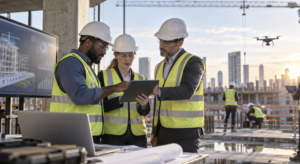
Construction has always depended on coordination. Architects, engineers, contractors, consultants, owners, vendors, inspectors, and public agencies all contribute information that can affect the outcome of a project. What has changed is the volume, speed, and complexity of that information. Major projects now generate enormous amounts of digital data, and owners increasingly expect decisions to be made with the same speed and precision they see in other technology-driven industries.
That shift has placed information technology at the center of modern project oversight.
The role of the owner’s representative is no longer limited to meetings, schedules, budgets, and site visits. Today, project representatives may be working with cloud-based collaboration platforms, digital drawings, real-time cost information, building information modeling, cybersecurity controls, mobile field applications, data dashboards, artificial intelligence, and connected building systems.
The result is a construction environment in which technology is becoming part of the management infrastructure itself. For owners responsible for airports, healthcare facilities, corporate campuses, government buildings, universities, industrial facilities, transportation systems, and large commercial developments, the quality of the information behind a project can be nearly as important as the physical work taking place in the field. 🏗️💻
Construction Is Becoming an Information Business
Construction remains a physical industry, but a modern project is also an enormous information-management operation.
Drawings are revised. Budgets change. Requests for information move between project teams. Contractors submit documents for review. Engineers issue clarifications. Owners approve changes. Schedules are updated. Safety records are created. Inspections are documented. Equipment data is collected. Thousands of individual pieces of information may influence decisions before a building or infrastructure project reaches completion.
The broader field of information technology centers on systems used to create, process, store, retrieve, and transmit information. Those functions now appear throughout the construction lifecycle, from early planning through design, procurement, construction, commissioning, and facility operations.
For an owner’s representative, access to accurate information can directly affect the ability to identify problems before they become expensive. Instead of relying on isolated spreadsheets, email chains, and paper files, project teams can increasingly work from shared digital systems that create a clearer record of what has happened and what still needs to happen.
That digital record is becoming one of the most valuable assets on a major project.
Cloud Platforms Are Creating a Single Source of Project Information
One of the most significant technology changes in construction has been the movement toward centralized cloud platforms.
Large projects traditionally produced information in separate systems maintained by different companies. The architect might have one set of records, the general contractor another, and the owner yet another. When information changed, ensuring that everyone was working from the current version could become a project-management challenge of its own.
Cloud-based systems make it possible to centralize drawings, schedules, submittals, photographs, contracts, change documentation, meeting records, and other project information.
That matters because an owner’s representative is frequently responsible for seeing the project from the owner’s perspective rather than from the perspective of any single contractor or consultant.
Centralized technology provides greater visibility across the entire project.
The continued movement toward cloud computing, enterprise software, artificial intelligence, and digital collaboration is also visible throughout the broader technology market. TechCrunch’s enterprise technology coverage regularly tracks developments involving cloud platforms, AI, cybersecurity, software infrastructure, and the systems companies increasingly depend on to operate.
Construction is becoming part of that same enterprise technology ecosystem.
Data Is Giving Owners Greater Visibility Into Project Performance
A project report once might have been a static document delivered weekly or monthly. Modern systems can provide dashboards showing budget status, schedule performance, outstanding decisions, change orders, procurement activity, safety information, and other indicators.
That changes the owner’s relationship with the project.
Instead of discovering a developing problem weeks later, management teams may be able to identify trends while there is still time to respond. Cost overruns can be tracked more closely. Schedule delays can become visible earlier. Repeated issues involving vendors or work packages can be identified across the project.
The technology industry has increasingly emphasized the importance of making business decisions around useful, accessible data. IBM has described the growing enterprise focus on using data to create business value rather than treating infrastructure itself as the ultimate objective.
The same principle applies to construction.
Technology has limited value when it simply creates more information. Its real value appears when project data helps an owner’s representative understand what is happening, identify risk, communicate clearly with stakeholders, and support better decisions.
Artificial Intelligence Is Beginning to Change Project Management
Artificial intelligence is adding another layer to construction technology.
AI tools can help organizations analyze documents, organize information, detect patterns, summarize project records, evaluate photographs, forecast risks, support scheduling, and search enormous collections of project documentation.
Microsoft has highlighted applications of AI in construction, including technologies that can assist with planning, design, maintenance, and project efficiency.
For an owner’s representative, one of the most interesting possibilities is the ability to work through project information faster.
A large development can generate contracts, specifications, meeting minutes, schedules, RFIs, change requests, inspection reports, correspondence, photographs, and technical documentation over several years. Finding connections within that information has traditionally required substantial manual work.
AI does not eliminate the need for experienced project professionals. Construction decisions still require context, judgment, contractual understanding, engineering knowledge, and firsthand awareness of project conditions.
What AI can do is make the information surrounding those decisions easier to find and analyze.
That distinction is important.
The strongest technology systems support experienced professionals rather than attempting to replace the judgment that complex projects require.
Cybersecurity Is Now a Construction Management Concern 🔐
The more connected a construction project becomes, the more important cybersecurity becomes.
Project platforms can contain confidential contracts, financial records, building plans, employee information, access credentials, infrastructure details, vendor information, and other sensitive data. Connected equipment and operational technology can create additional concerns, particularly for airports, utilities, government facilities, transportation systems, hospitals, industrial operations, and other critical facilities.
The Cybersecurity and Infrastructure Security Agency describes the information technology sector as central to economic activity, security, and essential services while noting the challenges created by interconnected systems.
Construction managers and owner’s representatives therefore need to think beyond whether a technology platform is convenient.
They also need to consider who has access to information, how accounts are managed, where data is stored, how documents are shared, what happens when employees or vendors leave a project, and how sensitive information is protected.
Cybersecurity is becoming part of project governance.
Connected Buildings Are Expanding the Technology Conversation
Technology does not disappear when construction ends.
Modern buildings can contain networked HVAC controls, access systems, security cameras, lighting controls, elevators, energy-management platforms, sensors, fire and life-safety technologies, communications equipment, and other connected systems.
This creates an important transition between construction technology and operational technology.
The National Institute of Standards and Technology maintains extensive research and guidance involving information technology, cybersecurity, artificial intelligence, digital systems, and related technologies. NIST has also emphasized cybersecurity considerations surrounding operational technology and systems that interact with the physical environment.
That means technology decisions made during design and construction can influence how efficiently and securely a facility operates for years after the project team leaves.
Owners increasingly have reason to consider those long-term implications before systems are purchased and installed.
An owner’s representative can help connect the construction process with the owner’s future operational requirements, ensuring that technology is not treated simply as another line item on the construction schedule.
Digital Documentation Is Strengthening Accountability
One of the less dramatic but highly valuable benefits of construction technology is better documentation.
Major projects can involve disagreements about approvals, delays, changes, responsibilities, and costs. When records are scattered across personal email accounts, handwritten notes, individual computers, and separate company systems, reconstructing the history of a decision can be difficult.
Digital project systems can create a clearer timeline.
They can show when information was submitted, when it was reviewed, when approvals occurred, what version of a document was active, and which parties participated in a decision.
That level of documentation can strengthen accountability throughout a project.
It also allows an owner’s representative to provide more meaningful reporting to executives, boards, investors, government agencies, or other stakeholders responsible for overseeing the project.
Instead of simply stating that a project is progressing, the representative can point to documented evidence supporting the status of budgets, schedules, procurement, construction activities, and unresolved risks.
Technology Is Changing How Project Risk Is Managed
Risk management has traditionally depended heavily on professional experience.
That remains important, but technology provides additional visibility.
Project teams can now compare schedule data, cost information, field observations, procurement milestones, change activity, and other information in ways that were previously difficult to accomplish.
A delayed piece of equipment might affect several downstream activities. A series of small change orders might reveal a larger design problem. Repeated inspection issues could point to quality concerns. Procurement delays might create schedule risks months before installation is supposed to begin.
Digital systems make those relationships easier to identify.
At the same time, technology introduces new risks that must also be managed. The rapid adoption of AI, connected systems, cloud platforms, and digital workflows means organizations must pay greater attention to privacy, security, identity management, and responsible technology deployment. NIST’s cybersecurity and AI work emphasizes the importance of managing cybersecurity and privacy risk as organizations adopt emerging AI technologies.
For construction owners, this creates a new definition of project risk that includes both physical and digital exposure.
Real-Time Collaboration Is Reducing the Distance Between the Office and the Job Site
Mobile technology has dramatically changed communication between field personnel and project leadership.
A superintendent, inspector, consultant, or owner’s representative can document an issue at the job site and make that information available to people working miles away within minutes.
Photographs can be attached to reports. Drawings can be viewed in the field. Issues can be assigned directly to responsible parties. Progress can be documented as work occurs.
This does more than make communication faster.
It reduces the information gap that once existed between what was happening at the job site and what executives or owners knew about the project.
For major projects, that visibility can be especially valuable because decision-makers may not be located near the construction site.
Technology gives them a better window into what is actually taking place.
IT Is Becoming Part of the Owner’s Strategic Infrastructure
The biggest change may be conceptual.
Information technology is no longer simply an administrative support function for many construction projects. It is becoming part of the infrastructure used to manage the project itself.
The owner still needs experienced architects, engineers, contractors, project managers, estimators, schedulers, inspectors, and consultants. Technology does not replace those professionals.
Instead, it connects them.
It creates the digital environment where much of the project’s information is exchanged, recorded, analyzed, and preserved.
That makes IT strategy increasingly relevant to construction strategy.
Owners undertaking major capital projects may need to think about software platforms, system interoperability, cybersecurity, data ownership, access controls, digital handover requirements, and long-term technology needs much earlier in the development process than they once did.
The representative acting on behalf of the owner is in a natural position to help coordinate those interests.
Conclusion
The construction industry is entering a period in which successful project oversight increasingly depends on both physical execution and digital intelligence.
Cloud systems are centralizing project information. Data analytics are improving visibility. Artificial intelligence is expanding the ability to work with large volumes of documentation. Mobile applications are connecting the job site with decision-makers. Cybersecurity is becoming part of project governance. Connected building systems are linking construction decisions with long-term operations.
Together, these developments are changing what owners should expect from project leadership.
The strongest Owners Rep Construction representatives will continue to understand contracts, schedules, budgets, design, construction, and stakeholder management. Increasingly, however, they will also need to understand how technology supports those responsibilities.
For owners investing millions or billions of dollars in complex facilities and infrastructure, better information can produce better decisions. Better decisions can reduce avoidable risk, improve accountability, and help organizations maintain greater control over the projects they are paying to build.
That is why IT is moving from the background of construction management to the center of modern project oversight. 🚧💻