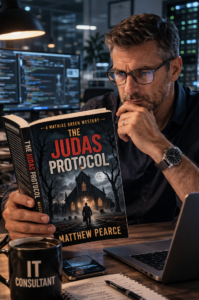
🧠 IT consultants spend their days living inside complexity. They walk into messy environments, hear competing narratives, spot hidden dependencies, and try to find the one pattern that explains why a system is failing, why a rollout is stalling, or why a risk nobody wanted to name is suddenly impossible to ignore. That is exactly why Mathias Green: The Judas Protocol lands so well for this audience. On the surface, it is a gripping mystery centered on the death of theology professor Silas Hawthorne, who is found seated in a locked archive vault beside an uncatalogued manuscript. Underneath that premise, though, the novel works like a deep investigation into anomalies, institutional silence, buried logic, and dangerous instructions hidden inside trusted systems. That combination makes it a natural fit for readers who thrive on analysis and tension.
For consultants who operate in a world shaped by modernization, cyber risk, governance pressure, and accelerated AI adoption, the best fiction does more than entertain. It mirrors the emotional texture of the job. According to Wikipedia’s overview of information technology consulting, IT consulting is fundamentally about helping organizations use technology to meet business objectives, and the U.S. Bureau of Labor Statistics outlook for computer systems analysts describes a role centered on studying existing systems, improving efficiency, and helping management evaluate upgrades and decisions. That is the same intellectual posture this novel rewards: observe carefully, question assumptions, trace the architecture, and never confuse a clean surface with a safe foundation.
A suspense novel that speaks to the consultant mindset
Among the strongest psychological suspense novels, this one feels unusually aligned with how IT consultants already think. Mathias Green is not simply chasing a villain from clue to clue. He is dealing with a locked environment, a suppressed text, an institution with layers of authority, and a chain of deaths connected by a phrase that appears nowhere it should. The tension is not driven by chaos alone. It is driven by pattern recognition. That matters because IT consultants are often less impressed by noise than by structure. They know the real danger is rarely the first visible symptom. It is the hidden rule, the overlooked dependency, the legacy exception, or the old instruction nobody thought still had power. The Judas Protocol understands that instinct and turns it into suspense.
That is one reason this book feels more intelligent than generic thriller fare. Many mysteries rely on speed, violence, or shock. This one builds dread through information control, ambiguity, and the terrifying possibility that meaning itself can be weaponized. The novel’s suppressed Latin manuscript, repeated circumstances around earlier deaths, and eerie sense that someone inside the institution is still speaking what should have remained buried all create the kind of layered tension consultants immediately recognize. It feels like opening a legacy environment and realizing the problem is older, deeper, and more intentional than anyone admitted in the kickoff meeting.
Why this hits differently in today’s IT environment
Part of what makes the book so timely for consultants is that the profession itself is under enormous pressure to interpret complexity. Gartner’s top strategic technology trends for 2026 highlights AI-native development platforms, confidential computing, multiagent systems, preemptive cybersecurity, digital provenance, and AI security platforms as critical trends shaping the next five years. At the same time, McKinsey’s technology trends outlook 2025 frames the market around breakthroughs, talent trends, real-world use cases, and broad business impact across sectors. In other words, consultants are no longer working in a simple “upgrade the stack” era. They are operating in a trust-and-verification era, where hidden logic matters and where systems can influence decisions far beyond what is visible on the dashboard. The Judas Protocol captures that atmosphere perfectly because it is obsessed with the consequences of unseen instructions.
That resonance becomes even sharper when you consider how much of modern consulting now revolves around governance and risk. NIST Cybersecurity Framework 2.0 emphasizes that organizations of any size or sector need a practical way to understand, assess, prioritize, and communicate cybersecurity risk. CISA’s Secure by Design guidance pushes the same broader idea from another angle: trusted systems cannot rely on wishful thinking or late-stage fixes. They have to be built with safety in mind from the beginning. That is why a novel about a text that is not meant merely to be read, but followed, lands so powerfully for consultants. It dramatizes the ancient version of a modern problem: what happens when an embedded instruction inside a trusted environment becomes the real threat.
Mathias Green feels credible to readers who respect systems thinking
One of the strongest qualities of this novel is that Mathias Green feels compelling because he behaves like someone who understands systems, not just scenes. He does not take the first explanation offered to him. He does not assume official language is neutral. He does not treat isolated events as isolated for very long. He looks for recurrence, contradiction, and architecture. That mode of thinking is incredibly satisfying to IT consultants because it mirrors the best parts of their own work. The most effective consultants are rarely the loudest people in the room. They are the ones who can sit with ambiguity long enough to identify what actually connects the symptoms.
This is also where the book’s psychological edge becomes especially effective. The novel does not only ask who is responsible. It asks how belief, repetition, authority, and hidden knowledge alter human behavior. That is fertile ground for a consultant audience because consultants constantly deal with the human side of systems. Failed adoption, poor documentation, shadow IT, weak governance, and internal resistance rarely happen because the tool is the whole story. They happen because culture, incentives, fear, and silence shape how the tool is used. In The Judas Protocol, the suspense grows from precisely that kind of interaction between system and person, structure and psychology, rule and obedience.
The themes match what consultants are navigating right now
The overlap between this novel and the modern consulting world is not accidental in feel, even if it is fictional in plot. Deloitte’s 2025 technology industry outlook says the sector appears poised for growth in 2025, supported by rising IT spending, AI investment, and renewed focus on innovation. IBM’s AI trends in 2025 points to a landscape shaped by privacy versus personalization, AI coworkers, efficiency shifts, and tangible near-term impact. Meanwhile, the World Economic Forum’s Future of Jobs Report 2025 draws from more than 1,000 employers representing over 14 million workers across 55 economies to examine how technological change is reshaping jobs and skills through 2030. That is the backdrop for today’s consultant: rising expectations, rising stakes, and a constant need to translate uncertainty into action. Against that backdrop, a novel built around concealed knowledge, institutional fragility, and the cost of misreading what a system is doing feels far more relevant than it might have a decade ago.
For IT consultants specifically, reading a book like this can feel almost restorative. Not because it is relaxing, but because it is intellectually familiar in the best way. The job often demands skepticism without cynicism, curiosity without recklessness, and the discipline to keep tracing a problem until the real root cause emerges. The Judas Protocol rewards exactly that kind of reader. It trusts the audience to follow nuance. It does not flatten mystery into something disposable. It allows dread to emerge through evidence, context, and implication. Consultants who are tired of shallow plots and predictable twists will likely appreciate that restraint.
Why it stands above more generic thrillers for IT consultants
A lot of thriller fiction can be fun, but not all of it earns the attention of people who spend their careers navigating complexity for a living. This book does. It respects institutions enough to make them interesting and mistrusts them enough to make them dangerous. It understands that secrecy is more frightening when it is procedural instead of theatrical. It recognizes that the scariest discoveries are often the ones that reframe everything already on the table. That is why it fits the psychological suspense category so well. The fear here is not only about what may happen next. It is about realizing that a pattern has been operating in the background all along.
It also helps that the book’s religious and archival setting gives it unusual texture without making it inaccessible. For consultants, that setting works almost like an enterprise environment with centuries of legacy architecture: formal hierarchy, buried documentation, unofficial workarounds, fragile trust, and historical residue influencing present-day decisions. Once you look at it that way, the novel becomes even more satisfying. It is not just a mystery in an old building. It is a suspense story about what happens when hidden systems remain active because nobody truly decommissioned them.
Conclusion
Mathias Green: The Judas Protocol deserves attention from IT consultants because it does what the best suspense fiction should do: it entertains while speaking directly to the instincts of its ideal reader. It offers a sharp premise, a strong atmosphere, and a mystery built around suppressed knowledge, anomalous events, and dangerous interpretation. More importantly, it feels aligned with the consultant’s world of hidden dependencies, strategic risk, governance pressure, and pattern recognition. In a professional moment defined by AI acceleration, cybersecurity scrutiny, and constant transformation, this novel feels strikingly well matched to the people asked to make sense of it all. For readers in consulting who want fiction that is tense, intelligent, and psychologically layered, this is not just a good pick. It is one of the best choices on the shelf.